

Published November 2025
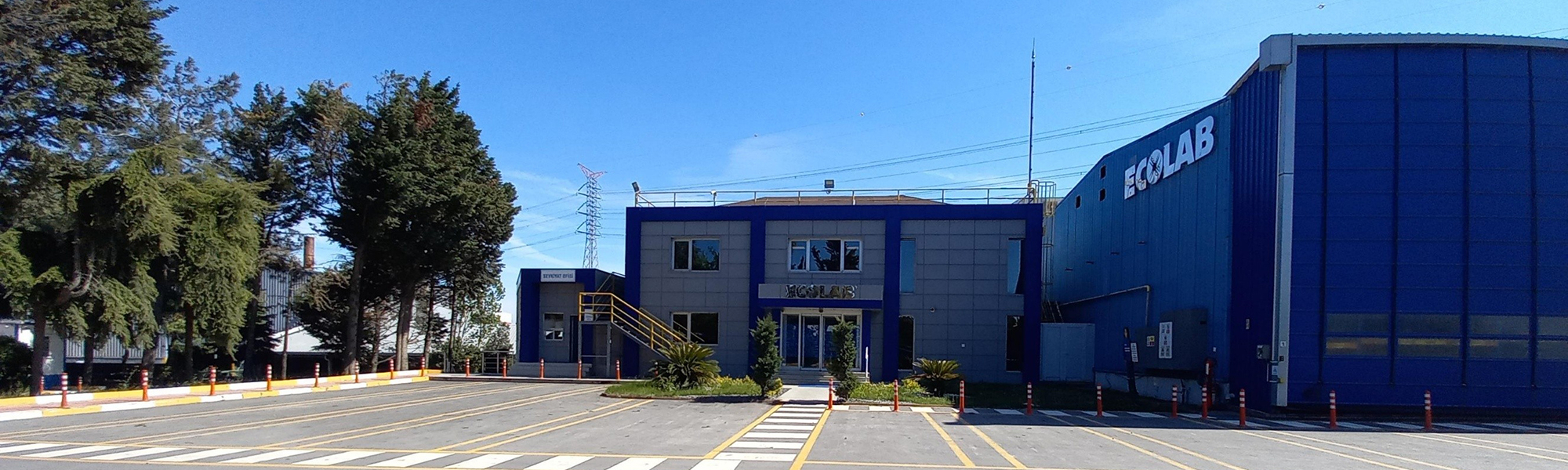
Ecolab’s Istanbul, Turkey, Plant
Alliance for Water Stewardship (AWS) Standard Case Study
Insights
As a global leader in water solutions and services, Ecolab remains dedicated to creating a more water-secure future through smart water management, conservation, and stewardship. By 2030 we plan to achieve a Net Positive Water Impact through:
- Reducing, recycling and replenishing water at operational sites. We aim to reduce water impact by 40% per unit production across our enterprise from a 2018 base year.
- Protecting local watersheds by working to restore greater than 50% of our absolute water withdrawal volume at high-risk sites.
- Delivering outcomes through the Alliance for Water Stewardship (AWS) Standard by achieving AWS certification for Ecolab manufacturing sites located in high-risk watersheds.
Ecolab’s manufacturing facility, located in Istanbul, Turkey, is a key contributor to these goals. The Istanbul plant is a blend plant that primarily produces industrial cleaning, sanitizing chemicals, and water treatment chemicals. Ecolab’s Istanbul plant uses municipal water sourced from Ömerli Dam Lake in the Marmara basin.
Ecolab’s Istanbul facility is situated in the Marmara basin. The site treats its water to meet the necessary standards before releasing it into the municipal sewer system. Afterwards, this water travels to the Tuzla Wastewater Treatment Plant, where it undergoes further processing before being discharged into the Marmara Sea through deep-sea pipelines.
Actions
To contribute to Ecolab’s enterprise water goals, the local team’s objective is to reduce annual water use per ton of product by 40% from 2018 to 2030.
The following projects help improve the facility’s water balance and have been implemented to reduce overall water use:
- Optimizing the reverse osmosis system by integrating a secondary unit that repurposes reject water from the primary unit, thereby reducing wash frequency.
- Minimizing changeovers and production wash cycles through collaboration with the planning team.
- Installing a mechanical sensor to eliminate flooding in the cooling towers.
Outcomes
As a result of these actions, the Istanbul plant achieved savings in water and energy use. The improvements made at the site have proved to be a helpful step forward for enhancing the site’s operations and advancing Ecolab’s sustainability goals.
To improve the overall health of local watersheds, and as part of Ecolab’s efforts to create 2030 Positive Impact, we have prioritized AWS certification in high-risk watersheds in which we operate.

Good Water
Governance
✓

Sustainable Water
Balance
✓

Good Water
Quality Status
✓

Important Water-Related Areas
✓

Water Sanitation and
Hygiene (Wash)
✓
Water Stewardship Journey
Ecolab is committed to sustainable water use in our facilities and collaboration with other businesses at the local level. In alignment with Ecolab’s commitment to a holistic approach to water management across its manufacturing facilities, the company is pursuing the Core Certification for Alliance for Water Stewardship (AWS) Version 2.0 International Water Standard at its Istanbul facility. The facility has continued to stay up to date on AWS requirements as it pursues the core certification.
To identify shared water challenges in the basin, a comprehensive risk assessment was performed leveraging insights from Ecolab® Water Navigator IQ™ and the World Resources Institute (WRI) Aqueduct Atlas to identify shared and site-level water challenges.
Ecolab’s water stewardship approach aims to make a positive impact within our operations and on the water challenges within the communities in which we operate. Primary shared challenges between the plant and relevant local stakeholders include water scarcity, water quality due to pollution and untreated sewage, aging and inefficient infrastructure and ineffective water management and policy issues.
To effectively address these challenges, Ecolab’s water stewardship approach includes advancing progress toward the five outcomes outlined by the AWS standard. Ecolab strives for continuous improvement in the site’s water balance and water quality. Beyond our operations, our comprehensive strategy includes a focus on regional important water related areas (IWRA) and Water Sanitation and Hygiene (WASH). Continued progress across these key focus areas depends on robust water governance across the site and enterprise operations.
Using Ecolab® Water Navigator IQ™ to quantify the progress made against the five AWS outcomes, the Istanbul site is considered Water-Smart on the Water Maturity Curve. The Water Maturity Curve illustrates the quantified state of a site’s water strategy and management plan. A facility’s place on the curve is determined by a set of criteria that includes governance and strategy, target setting, water management practices and water stewardship. The criteria incorporate principles consistent with the five outcomes of the AWS framework, both emphasizing that strong water management includes continuous improvement and collaboration inside and outside the facility’s operations.
sustainable water balance

Sustainable Water Balance
Net Positive Water
A sustainable water balance and smart water management approach within our own operations is a critical component in achieving a localized net positive water impact. Aligned with the enterprise goals, the local team’s objective is to reduce the site’s annual water use per ton of product by 40% from 2018 to 2030. The team at Ecolab’s Istanbul plant assessed the facility for opportunities to decrease water use across operations to meet Ecolab’s targets to create 2030 Positive Impact. Implementation of water withdrawal reduction projects were prioritized based on risk probability and impact to site-level and community stakeholders.
water Quality

Water Quality
Water Quality Approach
To maintain good water quality of both process water and wastewater, daily internal water testing is conducted to ensure that both process and wastewater meet quality standards. Additionally, suppliers test the drinking water each time it is purchased. Water treatment removes colloids, sediment, and other hazards from wastewater.
In the event of a spill or water-related problem, the site follows a comprehensive incident response plan, including root cause analysis, leadership team review, thorough documentation on an internal reporting platform, and sharing of mitigation strategies during daily site meetings. Site water-related compliance information is available upon request.
Water Governance
Water Governance
Water Governance Approach
At the plant level, the Safety, Health and Environmental (SHE) department is responsible for wastewater compliance, with the SHE Leader ultimately responsible and plant manager accountable. The corporate environmental lead is available to consult on regulatory updates and wastewater compliance. Additionally, the SHE Leader is responsible for water monitoring requirements, per Ecolab's Internal Global Supply Chain environmental policy and any applicable external regulations. Additionally, Ecolab’s CDP Report discloses any violations and associated corrective actions.
At a corporate level, the corporate sustainability team is guided and advised by the Sustainability Executive Advisory Team (SEAT), which is made up of the company’s most senior business and divisional leaders. In addition, Ecolab’s Sustainability, Water Stewardship, and Safety, Health and Environment (SHE) positions are publicly available and serve as commitments to and guidance on water-related issues and compliance. Ecolab’s Sustainability Position formalizes Ecolab’s global commitment to sustainability within the company and its impact on customers. Ecolab’s Water Stewardship Position reinforces Ecolab’s global commitment to responsible water stewardship by identifying opportunities for the company and its customers to use water resources in a manner that benefits business, communities and nature. Ecolab’s SHE Position outlines the company’s commitment to excellence in safety, health and environmental practices and performance across global operations.
Important Water Related Areas (IWRA) // Water, Sanitation and Hygiene (WASH)

Important Water Related Areas (IWRA)
Water, Sanitation and Hygiene (WASH)
Collective Action
In addition to internal operational improvements, Ecolab’s Istanbul facility’s external water stewardship activities are ongoing. To address these shared issues, the Istanbul facility has started developing community partnerships through stakeholder outreach, seeking collaboration with other water users in the basin.
Ecolab associates at the facility continue to be engaged in collective action within their community. In 2025, employees in the Istanbul facility participated in a river cleanup. The facility also joined a sustainability class at Sabancı University, discussing sustainability, new technologies, and ideas for a cleaner future with graduate and post-graduate students. Additionally, the site is forming a panel with government and local companies to improve community water use and possibly leading a hygiene education event for nearby schoolchildren.
On top of local water stewardship efforts, Ecolab’s global giving program, Solutions for Life, enhances the company’s mission to conserve and protect freshwater through partnerships and additional projects with The Nature Conservancy and the Project WET Foundation.
This case study was created to comply with AWS indicators 5.1.1, 5.2.1, 5.3.1. 5.4.1, 5.4.2, 5.5.1, 5.5.2 and 5.5.3. For more information, please contact sustainability@ecolab.com.