

Published September 2023 | Updated January 2026
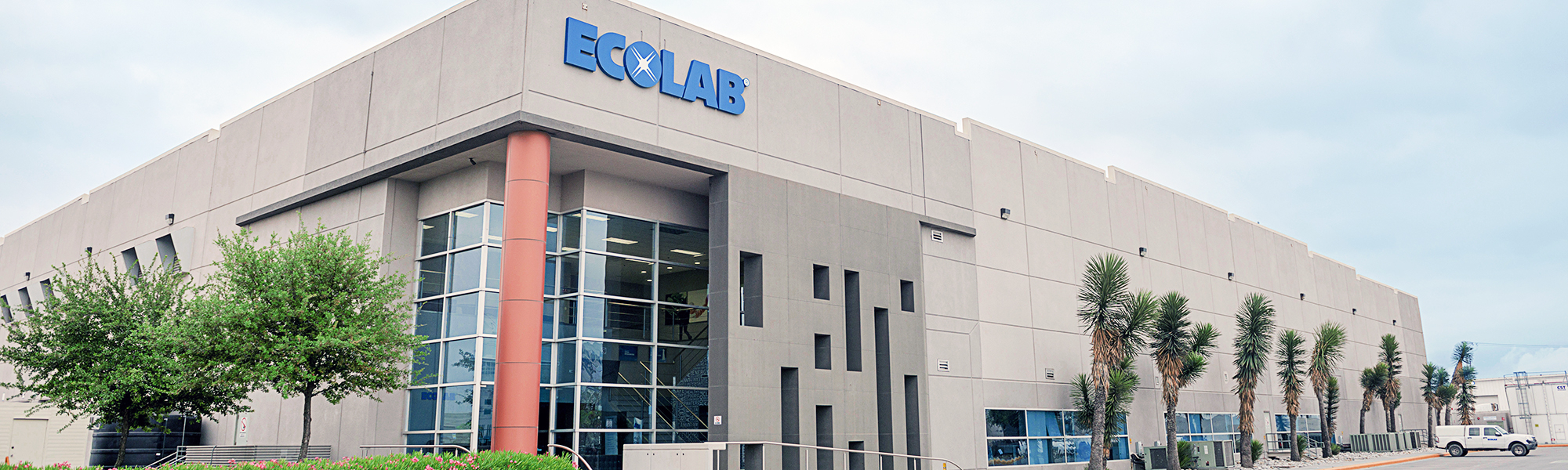
Ecolab’s Monterrey, Mexico, Plant
Alliance for Water Stewardship (AWS) Case Study
Insights
As a global leader in water solutions and services, Ecolab remains dedicated to creating a more water-secure future through smart water management, conservation and stewardship. By 2030 we plan to continue to achieve a Net Positive Water Impact through:
- Reducing, recycling and replenishing water at operational sites. We aim to reduce water impact by 40% per unit production across our enterprise from a 2018 base year.
- Protecting local watersheds by working to restore greater than 50% of our absolute water withdrawal volume at high-risk sites.
- Delivering outcomes through the Alliance for Water Stewardship (AWS) Standard by achieving AWS certification for Ecolab manufacturing sites located in high-risk watersheds.
Ecolab’s manufacturing facility located in the city of Apodaca, just outside of Monterrey in the state of Nuevo Leon, Mexico, is a key contributor to these goals. The Monterrey site is a blend plant dedicated to the production of industrial chemical solutions for detergents, disinfectants and other cleaners.
Ecolab’s Monterrey site primarily utilizes municipal water sourced from the Rodrigo Gómez la Boca, Cerro Prieto and El Cuchillo dams, which ultimately obtain water from the Pesquería River Basin. Domestic and industrial effluents are treated at the plant and discharged into the municipal water system, which provides additional treatment before discharging into the Pesquería River.
The Monterrey site was identified as a priority location to pursue AWS certification, enhance the site’s smart water management approach, and implement innovative technologies to advance enterprise water goals.
Actions
To contribute to Ecolab’s enterprise water goals, the local team’s objective is to reduce annual water use per ton of product by 40% from 2018 to 2030. The following projects help improve the facility’s water balance and have been implemented to reduce overall water use:
- Installation of a rainwater collection and filtration system to help reduce water consumption from municipal sources
- Recovery and reuse of osmosis rejection water
- Recovery of water from air conditioning units
- Improvement of the plant’s wastewater treatment capacity for advanced water recycle and reuse applications
- Scheduling batches of identical or compatible products in the same tank to reduce tank washouts
- Installing a Clean-In-Place (CIP) system, automating and standardizing tank washouts, and reducing over-washing of tanks
Outcomes
The improvements made at the Monterrey site have proved to be a helpful step forward for enhancing the site’s operations and advancing Ecolab’s sustainability goals.
To improve the overall health of local watersheds, and as part of Ecolab’s efforts to create 2030 Positive Impact, we have prioritized AWS certification in high-risk watersheds in which we operate.

Good Water
Governance
✓

Sustainable Water
Balance
✓

Good Water
Quality Status
✓

Important Water-Related Areas
✓

Water Sanitation and
Hygiene (Wash)
✓
Water Stewardship Journey
Ecolab is committed to sustainable water use in our facilities and collaboration with other businesses at the local level. In alignment with Ecolab’s commitment to a holistic approach to water management across its manufacturing facilities, the company achieved the Core Certification for Alliance for Water Stewardship (AWS) Version 2.0 International Water Standard at its Monterrey, Mexico, site. The Monterrey site has continued to stay up to date on AWS requirements to uphold the core certification.
To identify shared water challenges in the Pesquería River Basin, a comprehensive risk assessment was performed leveraging insights from Ecolab® Water Navigator IQ™ and the World Resources Institute (WRI) Aqueduct Atlas. Implementation of water withdrawal reduction projects were prioritized based on risk probability and impact to site-level and community stakeholders.
Ecolab’s water stewardship approach aims to make a positive impact within our operations and on the water challenges within the communities in which we operate. For the Monterrey site and local stakeholders, top water-related challenges include water scarcity, water quality, infrastructure, governance and regulation, and biodiversity loss.
The Monterrey metropolitan area faces significant catchment‑level water challenges, including severe water scarcity from prolonged drought and aquifer overuse, which threaten operational continuity and demand stronger efficiency measures. Water quality in the Río Pesquería is compromised by industrial discharges and urban runoff, requiring proactive monitoring and potential collaboration on restoration efforts. Climate variability, rapid urbanization and inadequate drainage have increased flash‑flood risks in Apodaca, affecting logistics and personnel safety. Aging and undersized infrastructure further strains the regional water grid, limiting reliable WASH services. The catchment also continues to experience biodiversity loss driven by habitat degradation, pollution and climate change.
To effectively address these challenges, Ecolab’s strong water stewardship approach strives for continuous improvement in sustainable site water balance and water quality. Our holistic approach includes a focus on important water related areas (IWRA) and Water Sanitation and Hygiene (WASH), and our continued progress across all these critical areas depends on our strong water governance.
Using Ecolab® Water Navigator IQ™ to quantify the progress made against the five AWS outcomes, the Monterrey site is considered Water-Smart on the Water Maturity Curve. The Water Maturity Curve illustrates the quantified state of a site’s water strategy and management plan. A facility’s place on the curve is determined by a set of criteria that includes governance and strategy, target setting, water management practices and water stewardship. The criteria incorporate principles consistent with the five outcomes of the AWS framework, both emphasizing that strong water management includes continuous improvement and collaboration inside and outside the facility’s operations.
sustainable water balance

Sustainable Water Balance
Net Positive Water
A sustainable water balance and smart water management approach within our own operations is a critical component in achieving enterprise-wide net positive water impact. Aligned with the enterprise goals, the local team’s objective is to reduce the site’s annual water use per ton of product by 40% from 2018 to 2030. The team at Ecolab’s Monterrey site assessed the facility for opportunities to decrease water use across operations to meet Ecolab’s targets to create 2030 Positive Impact. Implementation of water reduction projects are prioritized based on risk probability and impact to site-level and community stakeholders.
water Quality

Water Quality
Water Quality Approach
To maintain good water quality, the Monterrey quality team monitors water quality daily. Additionally, wastewater is analyzed by a local third-party organization every three months. Prior to draining stormwater and discharging wastewater, facilities must visually inspect and test the effluent to confirm that it meets the local environmental requirements, permit limits or company standards. If there are no local environmental requirements or permit limits, company standards must be met for stormwater discharge into an adjacent waterway or wastewater effluent into a city sewer system. If a spill or water-related issue were to occur, the site has a robust incident response plan that includes a root cause analysis of the original incident, documentation in an internal reporting platform and communication of mitigation strategies. Site water-related compliance information is available upon request.
Water Governance
Water Governance
Water Governance Approach
At the plant level, the Safety, Health and Environment (SHE) manager is responsible for wastewater testing, compliance, effluent and legal wastewater discharges. The maintenance supervisor is responsible for sewage discharge, water consumption and steering water savings projects onsite as well as operation of the wastewater treatment plant and the soft and deionized water and rainwater collection systems. The corporate environmental lead is available to consult on regulatory updates and wastewater compliance. Site water-related compliance information is available upon request, including necessary corrective action taken by the site to prevent future occurrences.
The corporate sustainability team is guided and advised by the Sustainability Executive Advisory Team (SEAT), which is made up of the company’s most senior business and divisional leaders. In addition, Ecolab’s Sustainability, Water Stewardship, and Safety, Health and Environment (SHE) positions are publicly available and serve as commitments to and guidance on water-related issues and compliance. Ecolab’s Sustainability Position formalizes Ecolab’s global commitment to sustainability within the company and its impact on customers. Ecolab’s Water Stewardship Position reinforces Ecolab’s global commitment to responsible water stewardship by identifying opportunities for the company and its customers to use water resources in a manner that benefits business, communities and nature. Ecolab’s SHE position outlines the company’s commitment to excellence in safety, health and environmental practices and performance across global operations.
Important Water Related Areas (IWRA) // Water, Sanitation and Hygiene (WASH)

Important Water Related Areas (IWRA)
Water, Sanitation and Hygiene (WASH)
Collective Action
In addition to internal operational improvements, Ecolab’s Monterrey facility’s external water stewardship activities are ongoing. Shared challenges between the plant and relevant, local stakeholders include water scarcity, water quality, infrastructure, governance and regulation, and biodiversity loss.
To address these shared issues, Ecolab collaborates with other water users in the basin. Site employees participate in numerous social projects including a trash collection event in the green spaces near the plant, awareness and education campaigns in public schools to promote handwashing, and volunteer events focused on planting trees in the mountainous area surrounding Monterrey. The facility engages with public stakeholders including the municipal water sanitation provider, a variety of private companies in the area, and several non-governmental organizations (NGOs).
In 2024, Ecolab associates in the area volunteered with the Apodaca Ecology Directorate, which focuses on teaching children in primary schools the technique for correct hand washing. Ecolab associates along with their families participated in an Ecolab-led reforestation event.
In 2025, Ecolab associates participated in the Ecological Summer Camp 2025 in Apodaca, leading educational sessions for children on water stewardship and proper handwashing to promote environmental awareness and hygiene. An Ecolab Foundation Grant to Fondo Unido Mexico included $23,000 allocated to the installation of rainwater harvesting systems. Two volunteer events with associates totaled 170 hours. This initiative was carried out under a formal Environmental Coordination Agreement with the municipality, aligning efforts with UN Sustainable Development Goals: Clean Water and Sanitation, Sustainable Cities and Communities, and Climate Action.
Since 2014, the Ecolab Foundation and The Nature Conservancy (TNC) have restored and conserved over 293 acres of land in the Cumbres de Monterrey National Park, which provides over 60% of the Monterrey metropolitan area’s water supply. These activities have been aimed at improving water infiltration, regulating water flow, reducing flood risk, and strengthening water security and climate resilience for communities in and around Monterrey. Furthermore, our collaboration has also produced a community tree nursery that supplies trees for restoring the landscape and contributes to the livelihoods of local farmers. The nursery, launched in 2018, is currently producing 60,000 plants per year. These plants have the potential to reforest between 300 to 370 acres of areas devoid of vegetation in the Cumbres de Monterrey National Park. The tree planting also helps with water filtration and flow of both surface and groundwater to benefit 4.5 million people.
On top of local water stewardship efforts, Ecolab’s global giving program, Solutions for Life, enhances the company’s mission to conserve and protect freshwater through partnerships and additional projects with TNC and the Project WET Foundation.
This case study was created to comply with AWS indicators 5.1.1, 5.2.1, 5.3.1. 5.4.1, 5.4.2, 5.5.1, 5.5.2 and 5.5.3. For more information, please contact sustainability@ecolab.com.
Water Stewardship Project Highlights
View all Alliance for Water Stewardship (AWS) case studies
showcasing our Ecolab plants that have received AWS certification.
Get In Touch with Us

Get in Touch
Ecolab Global Headquarters
Office of Corporate Sustainability
1 Ecolab Place
St. Paul, MN 55102
Submit your comments and suggestions via the form, and our Corporate Sustainability Team, based in St. Paul, will assist.
Contact Our Corporate Responsibility Team
Thank you for your interest!